Rain is good for gardens, of course. Too much of it, pooling in the wrong places in your yard, can cause drainage problems around your landscape and in your home.
“Proper drainage is probably one of the most important services that you should have around your home,” says Gardens of Babylon owner Mark Kerske. “You want to keep the water away from the foundation of your house.”
Water running into the basement or crawlspace can cause mold and other problems. Downspouts from the gutter can push rainwater into the foundation if they’re not properly routed. Water that leads to damage on any part of the property causes trouble over time. “The problem with poor drainage is erosion,” Kerske says. “It can affect the structure of your house or driveway.”
Change the course
There are several methods for guiding water away from the house, depending on the origin of the problem.
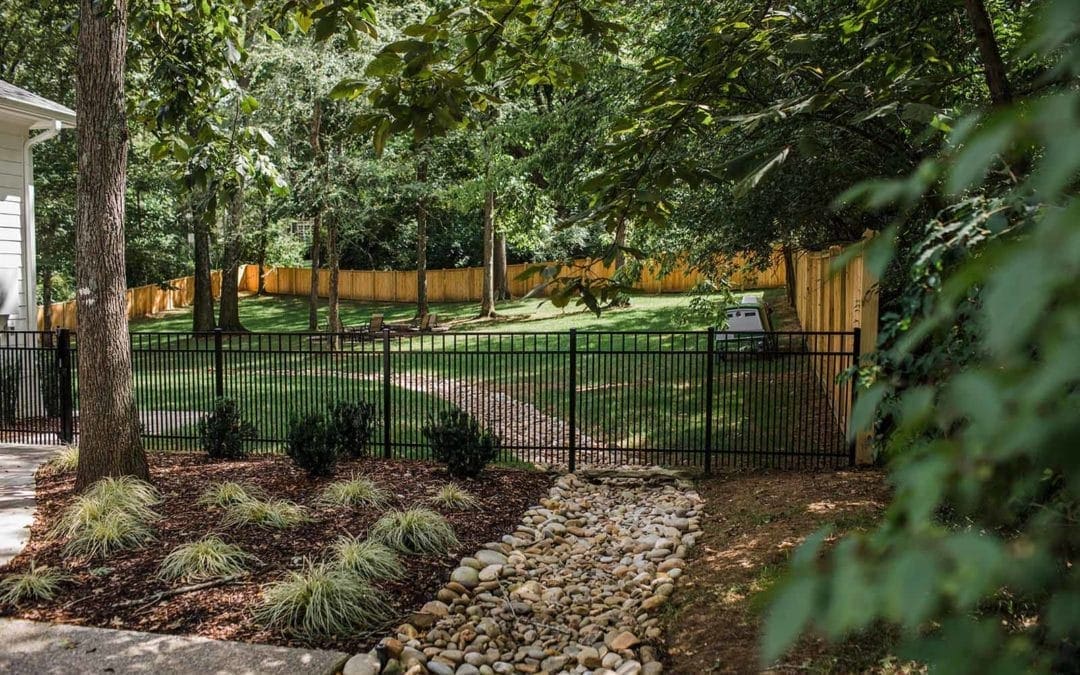
Downspout extension: If rainwater rushes through a gutter downspout near the foundation, a tube on the end of the downspout can empty rainwater farther away from the house during a downpour. The piping can be aboveground, or installed from the downspout in a trench that runs underground, out from under any mulched beds, where the water exits through a pop-up drainage emitter in the lawn.
Berm: The way water travels over the ground depends on the topography of the property, and if water naturally runs toward the house, a bern –a raised soil barrier or ridge — can be an effective way to direct water away from an area, Kerske says.
Swale: A trench-like depression in the ground forms a chute, of sorts, to direct the water flow. It can be lined with large chunks of rocks to slow the velocity of the water. “When you have a large amount of water coming toward your house, you want to slow it down,” he says. “If you direct water into the swale, you can get it to go where you want.”
Again, the lay of the land will suggest which method is best. “If the land behind the house is much higher, that’s where you really need a good swale or berm,” Kerske says. “The key is to move the water away from where it wants to naturally go.”
Design challenges
For any landscape design project, a designer and homeowner will discuss any drainage problems on the property that need to be addressed. “That’s the first step. We can do a drainage consultation and assess what the problem is.” Kerske says. “If it’s something they can’t do or don’t want to do, we can put together a design and calculate what it will cost to do the repairs.”
If the solution to a drainage problem calls for a swale or a berm, that can become part of the overall landscape design. “We can put native plants along the streambank. We can use groundcovers, and make it look like the swale belongs naturally in the landscape. That’s where a designer can really be of help,” Kerske says. “The designer can incorporate that drainage swale or berm into the landscape plans.”
Solving drainage and erosion problems in a landscape is the first step in any design plan, Kerske says. “There are so many hills here in Middle Tennessee. We do a lot of drainage work,” he says. “I think proper drainage is the most important part of landscaping.”
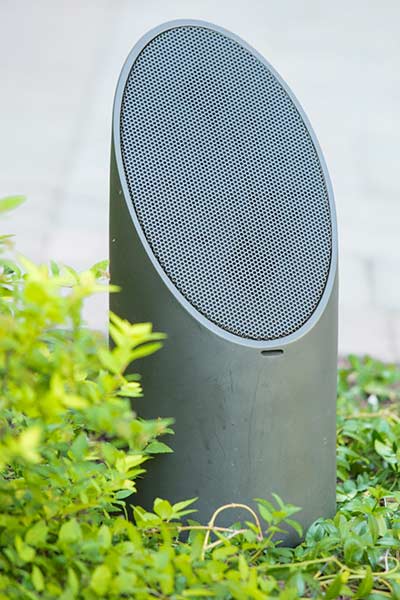
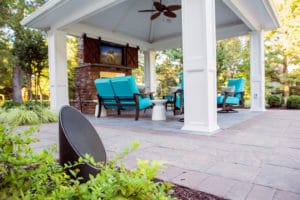
Imagine relaxing in your personal outdoor retreat. It probably has comfortable seating, just the right amount of shade and sun, and soothing music all around. A custom sound system designed for the specific needs of your landscape takes outdoor music enjoyment to the next level. An outdoor audio system is a nice addition to your outdoor living area, says Eric Van Grinsven, a landscape designer with the Gardens of Babylon design team. A backyard retreat is the area where you can get away to when you need a break. “It’s your little spot you can disappear to or just relax and be surrounded by nature.”
Indoor, outdoor: What’s the difference?
Your favorite music sounds good indoors because there are walls and ceilings to bounce the sound back to your ears. But even the best indoor speakers, when they’re outdoors, send music out into the open where sound quality is diminished. A system designed for outdoor spaces balances the sound coverage throughout the area, tailored specifically to your landscape design. Outdoor speakers are also more durable, built to withstand the sun, wind, rain, cold, dust, dirt, bugs and other elements that you expect in an outdoor environment.
How does outdoor audio work?
Gardens of Babylon is a certified dealer of Coastal Source, a landscape audio systems company based in Moorestown, NJ. Chris Marshall, a Coastal Source landscape lighting and audio designer, explains that a landscape audio design specialist will consider the size, shape and needs of an area, based on the landscape design submitted by the dealer. The setup generally includes a power supply, amplifier, audio streamer and speakers.
Interested in including audio in your backyard retreat? Schedule a free phone consultation through the Irrigation, Lighting & Audio portal on the Gardens of Babylon website. You can also schedule an in-person audio demonstration to hear how outdoor audio can transform your outdoor living areas.
My name is Dana and I’m with Gardens of Babylon and today I’m going to share with you my success tips for container planting so that your containers will look professional!
What kind of soil is the best for container planting?
So let’s talk about soil in our containers. That’s something that most people overlook – they get caught up with the beauty of the flowers. But, actually, the soil is the most important component, because that’s what’s going to feed out beautiful plants and give them nutrients. You want to get the best quality potting soil that you can for your containers. And I love to use one that’s rated for outdoor containers; it already has some micronutrients in it. We have lots of great quality soil and lots of different brands to choose from at Gardens of Babylon!
Pro tip: If you have pots that dry out a lot or if they’re in the hot sun you can actually buy some play sand and put it in the bottom of your containers and that will actually hold more moisture for you throughout the season! That way, you don’t have to be watering multiple times a day.
Decorate your Porch
There’s three design elements for your containers that you can follow – you need a thriller (something eye-catching), a spiller (a plant that cascades over the edges of the pot), and a filler (something to fill space between the larger plants)!
I always love to incorporate ornamental grasses because they’re gonna be very vertical and that there’s movement which I love. If you want this to be seen from the road and kind of have some curb appeal and you want people to turn their head I always incorporate yellow! You just sort of notice yellow and it always makes you turn your head! I also love to add some white flowers, especially if you’re gonna do a lot of big bold colors! White is that design element that brings all the colors together.
You always want to fertilize your plants as well, it’s sort of like giving your plants vitamins! I love to use flower tone.
Whatever brand you decide to use you just want to use it per package direction whatever it says. So I would then sprinkle in my fertilizer, water this in really well. As if your planters are flushed to the ground on your patio or porch it’s always helpful to get some little legs or prop them up with bricks so that there’s a little bit of air movement underneath your planters because what happens is our soil will kind of settle and if it’s right there flush with your patio or your porch it could clog and it could actually cause water to sort of sit in the bottom and rot our roots. So it’s always a good idea to kind of lift up our pots up off the ground so that that water can drain out throughout the season.
Plant love being pruned
So let’s talk about plant maintenance throughout the year. So just like we cut our fingernails or go get haircuts our plants actually need some maintenance throughout the year and if not they get scraggly they don’t bloom as well so, I just wanna let you know that plants love to be pruned.
Feel free, you’re not hurting them in any way they actually love it when you trim them and actually promote some new growth and it keeps them bushier and healthier. So what I would do especially with Coleus they tend, they tend to get sort of leggy you can always just go and take your pruners or sometimes just your fingernails and just snip off right here right before a leaf node, and I’ll show you on this one on the future what I would do is I would take my pruners and just prune the right there.
You can always just trim off any leaves that have gotten hits and then that what that’s gonna do is create, it’s gonna send a hormone when it down to this leaf node, it’s gonna signal to the plant I can go ahead and grow some more and gave new buds. Same with this there’s always just gonna be some like little scraggly leaves, just look you know you can you should even take your fingernail. Now this is just normal you know plants are just gonna they’re living creatures and they gonna require just a little bit of maintenance.
So we’ve talked about fertilizer and soil and plant care and this is gonna help set you up for success so, don’t be shy plants are very forgiving and go have fun!
The pollination efforts of bees are behind one of every three bites that typical American eats. That accounts for about 15 billion dollars a year in US crop services. Here are 5 steps you can take to help local pollinators!
Five pollinator friendly steps home gardeners can take:
1) Eliminate invasive plants. Most of these are aggressive, non-native species that aren’t very attractive to pollinators anyway, but they are the biggest threat because they elbow out natives that are of high pollinator value.
2)Plant in clusters. Diversity is important but it’s also helpful to plant in floral clumps at least five plants per clump whether shrubs, perennials, annuals instead of this one here, one there, one there. Clusters are easier for pollinators to find and offer a bigger supply of pollen.
3) Allow some cosmetic or temporary damage on some of your plants. This is a sign that caterpillars may be munching on some of these pollinator friendly plants!The leaves break down in the landscape and become a kind of shelter for insect eggs.
4)Give pollinators a water source. Bird baths or water features are two good ways to help with this. Sallow puddles are excellent if you refresh your water every now and again to avoid any kind of mosquito collection and keep the pollinators well hydrated.
5)Eliminate or reduce chemical applications around your landscape or garden or try to choose natural pesticides when you have to apply around your property. If you do have to apply, choose to apply later in the evening when the sun has gone down. These are the times when pollinators aren’t active so it gives a chance for the treatments to dry before the next day.
Plants to add that help bees:
Butterfly weed, yarrow, echinacea or coneflower, catmint, lavender, agastache, butterfly bush
Be sure to grow the right type of variety! Rabbiteye blueberries are native to the southeast United State! So they do well with the heat and humidity. They tend to grow a little bit larger as well! Most varieties grow to be four to ten-feet tall. Make sure that you have enough space for these guys to grow nice and large.
Blueberries Come in Different Sizes and Varieties
There are some smaller varieties of blueberries. One of them that we love is called Sunshine blue. Sunshine blue maxes out around three feet tall by three feet wide – great for a large container! Or they can be used as foundation shrubs around the landscape. They are great in place of things like hydrangeas. They can even be used in the landscape as a plant if you don’t want to grow them off to the side or in a garden! Blueberries love full sun. They do not like the shade, so make sure that you have them in a really nice full sunny area and you’ll be just fine.
You also want to consider growing at least two varieties next to each other for cross pollination. This is how you get maximum berry yield. You’ll get a decent crop if you just have one but you’re really going to want to at least plant two varieties. Two different types growing near each other will help to make sure that you really get a maximum yield of blueberries.
Best Soil for Blueberries
Blueberries love acidic soil somewhere in the 4.5 to 6 range. Most of our natural soils are around the 7 range so you need to add soil-acidifying amendments to the soil. Organic elemental sulfur or cottonseed meal are both amendments that you use to lower the ph of your soil. They take one to two years to really take full effect so get started early. But you can also just plant them in the areas around the blueberry when you plant your shrub. They’ll take about one to two years to really lower the soil ph. Getting your soil very acidic is a key ingredient to being successful at growing blueberries.
You want to make sure that you are growing in a well-drained, evenly mixed composted soil. Like a lot of plants around here, they do really well if they’re not waterlogged and growing in heavy clay. Backfilling with some really great compost and maybe a little bit of sand for drainage mixed in will help to get them off to a really great start. Maybe even consider topping them off with a little pine straw or pine mulch around the base and then you’re going to be really successful.
Don’t Lose Your Blueberries to the Birds
Birds are attracted to blueberries. Here are some ideas to keep the birds mostly off of your blueberries:
Bird netting is really the kind of the go-to for a lot of gardeners. It’s a fine filament type netting that you can just kind of lay over your blueberry. You can get a little bit more elaborate with it and build frames around your blueberries in larger cages that kind of thing. But if you’re a little bit lazier you can just drape it over the blueberry bush. The birds might get the top blueberries but they’ll really miss a lot of the stuff that’s on the inside.
Hanging strips of what’s called flash tape or pie pans or CDs on string can keep birds at bay. This type of movement and shiny effect from the sun can kind of deter them away from getting onto your blueberry bushes!
Some people even put up bird feeding stations and feed them to avoid having them eating the crop. But, just make sure that you keep your bird feed well stocked because when that runs out they might be looking for other food sources.
We hope this video will help you learn how to grow blueberries in your own yard. For other great tips and DIY tutorials, subscribe to our Garden and Landscape Blog.